


Indoor Playground Cost & Budget Planning 101: A Practical Guide for Investors and FEC Operators
Search "indoor playground cost" and you will find numbers that don't agree with each other. One source quotes a few tens of thousands of dollars. Another cites project costs in the high six figures. Neither is wrong — they are simply describing different things.
The gap usually comes down to scope, not dishonesty. A venue in a converted retail unit with basic soft play and standard ceiling height has a different cost structure than a mall-anchor FEC with a five-meter clear span, a themed multi-level structure, and a full attraction mix. Location changes the picture again: site condition, local construction rates, and import logistics all move the final number in ways a generic average can't capture.
This guide is written for people who need to plan a budget before they start collecting supplier quotes — not after. It walks through what actually drives indoor playground cost, how to separate equipment price from total project cost, and how to read a supplier's quotation so you're comparing scope, not just a number on a page.
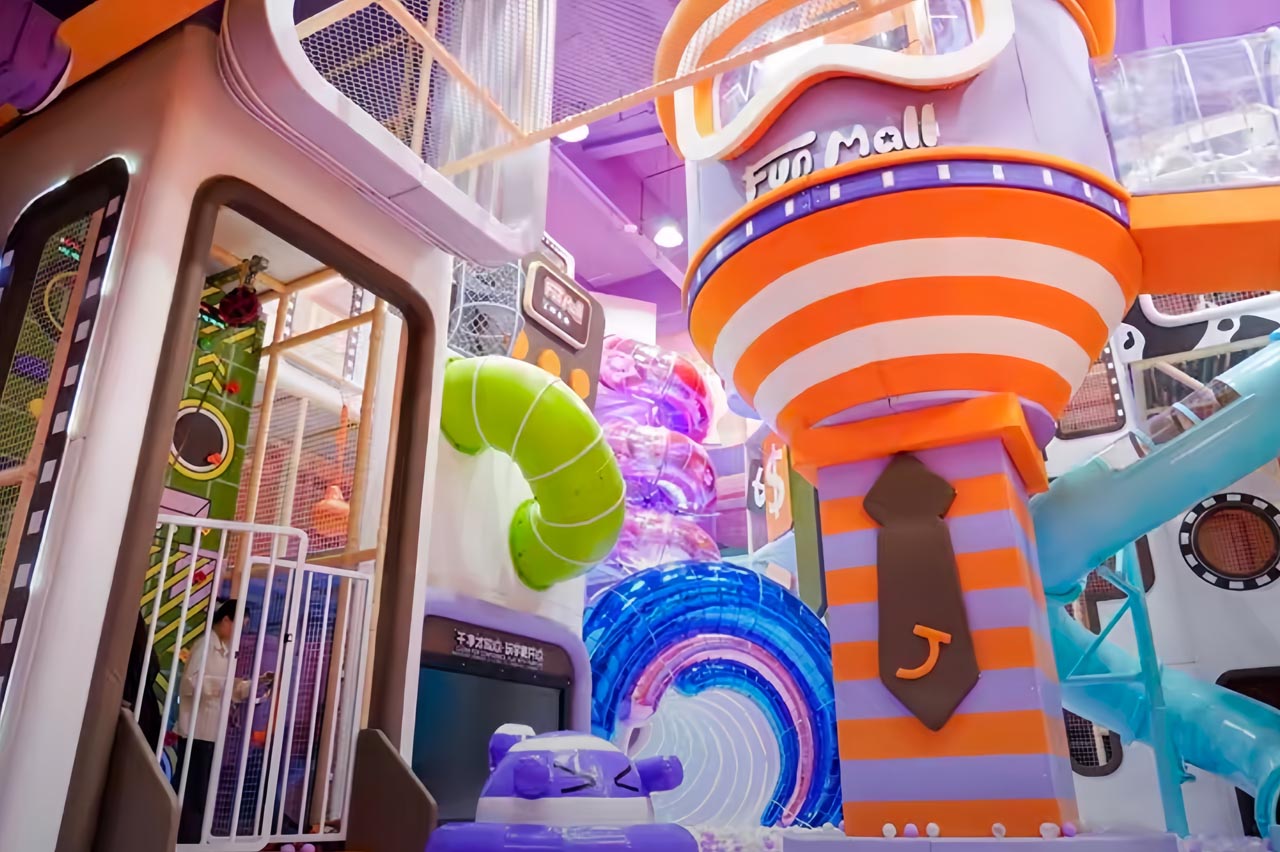
How Much Does an Indoor Playground Cost?
There is no single, reliable "average" cost for an indoor playground, and any figure presented as a universal number should be treated with skepticism. What exists instead is a set of cost bands tied to specific scopes of work.
Before any number is useful, it needs four qualifiers:
- What's included. Equipment only? Equipment plus safety flooring? Full interior build-out?
- What's excluded. Freight, customs, site preparation, and installation are commonly left out of an equipment-only figure.
- Where it applies. Labor rates, import duties, and construction costs vary sharply by country and even by city.
- What stage of the project it represents. An early budgeting range and a final signed quotation are not the same thing, and shouldn't be compared as if they were.
Cost per square meter or square foot is sometimes used as a shorthand for early screening. It can be a reasonable starting point when you're sizing up whether a floor plan is even feasible — but it breaks down quickly once you start comparing projects with different ceiling heights, attraction densities, or theming levels. Two 500 m² spaces can carry very different budgets depending on what's built inside them. Treat area-based pricing as a rough filter, not a quotation method.
What Actually Determines Indoor Playground Cost?
Every line item in a supplier's quotation traces back to a handful of underlying variables. Understanding these makes it much easier to read — and question — any quotation you receive.
Floor Area and Ceiling Height
Floor area sets the outer boundary of what's possible, but it doesn't scale linearly with cost. A larger footprint sometimes lowers the cost per square meter, because fixed costs like design and project management get spread over more space. Ceiling height matters just as much, if not more: a clear height that allows a second or third play level changes the entire structural approach, the slide configuration, and the total play capacity you can fit into the same footprint. Two venues with identical floor areas but different ceiling heights are, in practical terms, different projects.
Age Range and Capacity
A toddler-focused zone, a venue built for school-age children, and a mixed-age FEC each call for a different equipment profile. Toddler areas tend to prioritize soft, low-height structures with high safety margins. School-age and tween attractions can include taller climbing structures, more complex slide systems, and adventure or ninja-style elements. A mixed-age FEC usually needs distinct zones for each group, which increases both the design complexity and the equipment count — and with it, the budget.
Attraction Mix
Soft play, multi-level structures, slides, ball pools, trampolines, climbing walls, interactive attractions, and toddler zones each carry very different price points and space requirements. A 500 m² project built around a single multi-level soft play structure will cost differently than the same footprint split across five or six distinct attraction types. The attraction mix — not the square footage alone — is often the single biggest lever on total equipment cost.
Theming and Customization
Standard equipment, drawn from existing modular components, sits at one end of the spectrum. A fully custom, branded environment with sculpted theming, custom colorways, and bespoke structural elements sits at the other. The gap between the two is significant: custom design work, non-standard materials, and additional engineering time all add cost that a catalog-based structure doesn't carry. Neither approach is inherently "better" — the right level of customization depends on the venue's positioning and target audience.
Safety and Compliance
Safety requirements are not optional line items — they are a baseline that shapes material choice, structural design, and documentation from the start. Relevant frameworks include ASTM F1918 for soft-contained play equipment, ASTM F1487 for public-use playground equipment, and EN 1176/1177 for the EU market, alongside local fire codes and building regulations. Compliance is destination-specific: a certificate that satisfies one market does not automatically satisfy another, and project scope should account for the specific requirements of where the venue will operate.
Site Preparation
An existing building rarely arrives ready for an indoor playground without modification. Floor condition, electrical capacity, HVAC, fire suppression systems, restroom capacity, ceiling structure, access routes for delivery, and any existing partitions all factor into how much site work is needed before equipment installation can even begin. A shell space and a former retail unit with existing infrastructure represent very different starting points, even at the same square footage.
Shipping and Installation
For cross-border projects, landed cost includes factory-to-port transportation, ocean or air freight, customs clearance, duties and taxes, and destination handling — on top of the equipment price itself. Installation is a separate line: it typically involves an installation team, travel and accommodation where local labor isn't used, a defined installation timeline, and final testing and handover. These costs scale with distance, project complexity, and local labor availability, and should be scoped separately from the equipment price rather than assumed to be bundled in.
Operating Requirements
The capital needed to open the doors is only part of the financial picture. Staffing, cleaning, ongoing maintenance, insurance, utilities, POS or booking software, marketing, spare parts inventory, and working capital to cover the ramp-up period all draw on the same budget before the venue generates steady revenue. A budget that stops at "opening day" tends to underestimate what's actually required to operate successfully through the first several months.
Indoor Playground Cost Breakdown: What Should Your Budget Include?
A useful budget separates line items by category and flags which ones typically fall inside an equipment quotation versus which ones need a separate line. The table below is a planning framework, not a fixed allocation — treat the "Typically Separate?" column as a starting checklist to confirm with each supplier.
| Budget Category | What It May Include | Typically Separate from an Equipment Quote? |
|---|---|---|
| Design | Concept layout, 2D/3D renders, engineering drawings | Often bundled with turnkey scope; confirm for equipment-only quotes |
| Playground equipment | Structures, slides, soft play, interactive elements | Core of the quotation |
| Theming | Custom decor, sculpted elements, branded environments | Frequently a separate line or upgrade |
| Safety flooring | Impact-absorbing surfacing, matting | Sometimes included, often excluded |
| Freight | Factory-to-port and international shipping | Usually separate |
| Customs and duties | Import clearance, destination taxes | Usually separate |
| Installation | Labor, travel, testing, handover | Often separate or quoted as an add-on |
| Site preparation | Floor, electrical, structural adjustments | Separate — venue-specific |
| Electrical | Power supply for interactive attractions, lighting | Separate |
| HVAC | Climate control sized for occupancy | Separate |
| Fire safety | Suppression systems, signage, egress compliance | Separate |
| Interior renovation | Walls, ceilings, flooring outside the play area | Separate |
| Furniture | Seating, party room furnishings, reception | Separate |
| POS/ticketing | Admission, booking, and payment systems | Separate |
| CCTV/security | Surveillance, access control | Separate |
| Signage | Interior and exterior branding, wayfinding | Separate |
| Permits/inspection | Local approvals and code compliance | Separate — owner responsibility in most markets |
| Insurance | Liability and property coverage | Separate |
| Launch marketing | Opening campaign, local advertising | Separate |
| Initial staffing/training | Hiring and onboarding before opening | Separate |
| Working capital | Operating buffer through ramp-up | Separate — often underestimated |
| Contingency | Buffer for unplanned costs | Planning assumption, not a supplier line item |
Note: The "typically separate" column reflects common industry practice, not a fixed rule. Always confirm scope directly with each supplier rather than assuming based on this table.
Equipment Cost vs. Total Project Cost
This is where budgets go wrong most often. A supplier quotes a number for playground equipment, and that number gets treated as the cost of opening the venue. It rarely is.
It helps to think in four layers, each one wider than the last:
- Equipment price — the ex-factory cost of the play structures and attractions themselves.
- Landed equipment cost — equipment price plus freight, customs, duties, and destination handling to get the equipment to the venue.
- Turnkey project cost — landed equipment cost plus design, engineering coordination, and installation, where that scope is included.
- Total opening investment — turnkey project cost plus site preparation, interior build-out, permits, insurance, initial staffing, launch marketing, and working capital.
Illustrative example — not a Luckyplay quotation. Imagine two suppliers quote for the same 400 m² venue. Supplier A's equipment quotation is lower on paper, but it excludes freight, customs, and installation, and the destination site needs significant electrical and flooring work. Supplier B's number is higher, but it's a turnkey figure that already accounts for freight, installation, and basic site coordination. Once both are converted to a total opening investment, Supplier B may land at a similar — or even lower — total than Supplier A, once every excluded cost is added back in. The headline number alone tells you very little.
None of this means a lower equipment quote is a red flag, or that a higher turnkey number is automatically better value. It means the two numbers aren't measuring the same thing, and shouldn't be compared as if they were.
How to Build an Indoor Playground Budget Step by Step
The most reliable way to avoid the equipment-versus-total-cost trap is to build your own budget structure before a single supplier is contacted.
Step 1 — Define the Venue
Country and city, venue type, floor area, and ceiling height. These four facts alone will shape most of what follows.
Step 2 — Define the Customer
Target age range, family profile, expected capacity, and whether the venue serves a single age group or a mixed-age audience.
Step 3 — Define the Business Model
A standalone indoor playground, a mall-based FEC, a play café, a large multi-attraction FEC, a hotel or resort kids' facility, a mixed entertainment center, or a renovation of an existing venue — each implies a different cost structure and revenue model.
Step 4 — Define the Attraction Mix
Which combination of soft play, slides, climbing, interactive elements, and toddler zones fits the venue type and customer profile defined above.
Step 5 — Separate Equipment and Building Costs
Keep the equipment quotation distinct from anything related to the building itself — electrical, HVAC, fire safety, flooring, and interior finishes.
Step 6 — Add Logistics and Installation
For cross-border projects, confirm whether freight, customs, and installation are included in the supplier's number or need to be budgeted separately.
Step 7 — Add Operating and Working Capital Requirements
Staffing, insurance, POS systems, and a cash buffer for the first several months of operation before revenue stabilizes.
Step 8 — Add a Contingency
Unplanned costs are common in build-out projects, particularly where existing site conditions aren't fully known until construction begins.
Step 9 — Request Comparable Supplier Quotations
Only once the above is defined should quotations be requested — and they should be requested against the same defined scope, so the resulting numbers can actually be compared.
How to Compare Indoor Playground Supplier Quotes
Two quotations with different headline prices might represent identical scopes of work, or completely different ones. The only way to know is to compare scope directly, line by line.
A practical comparison checklist:
- Is 2D layout planning included?
- Is 3D design included?
- Are engineering drawings provided?
- Is the equipment quantity and specification clearly itemized?
- Are materials specified, not just described generically?
- Which safety standards does the equipment meet, and is documentation provided?
- Is certification or testing documentation included?
- Is freight included, and to which point (port, or door)?
- Are customs and duties included or excluded?
- Is installation included, and does it cover labor, travel, and accommodation?
- Is installation supervision or on-site quality control included?
- Are spare parts included or available separately?
- Is maintenance documentation provided?
- What warranty period and terms apply?
- What after-sales support is available once the venue is operating?
- Is project management included as part of the scope?
- Is site coordination with local contractors included?
- Are exclusions stated explicitly, or only implied?
This is the core of apples-to-apples quotation comparison: asking every supplier the same questions, in the same order, so the answers can be placed side by side. A quotation that answers all of these clearly is generally easier to trust than one that leaves most of them open.
Hidden Costs Investors Often Miss
These aren't guaranteed expenses on every project — they're categories worth checking before assuming they're covered:
- Freight and destination handling charges
- Customs duties and import taxes
- Site preparation beyond what was visible during initial planning
- Electrical capacity upgrades
- HVAC sizing for occupancy loads
- Fire protection system upgrades
- Impact flooring beyond the play area footprint
- Local permits and inspection fees
- Liability and property insurance
- Signage, wayfinding, and branding
- POS, ticketing, and booking software
- Furniture for reception, party rooms, and seating areas
- Installation team travel and accommodation
- Spare parts inventory for early operations
- Schedule delays that extend lease costs before opening
- Working capital to bridge the ramp-up period
Budget Planning by Project Type
Different venue formats concentrate their budget in different places. This table is a planning lens, not a price list.
| Project Type | Typical Characteristics | Main Budget Drivers |
|---|---|---|
| Small Soft Play | Compact footprint, younger children | Equipment, safety flooring, basic site fit-out |
| Play Café | Small to medium, F&B integrated | Equipment, seating, kitchen/café infrastructure |
| Mall Indoor Playground | Commercial retail environment | Design, equipment, fit-out, landlord/mall requirements |
| Standard FEC | Multiple attraction types | Attraction mix, capacity planning, supporting technology |
| Large/Flagship FEC | High-capacity destination venue | Custom design, theming, multi-attraction mix, construction scope |
How Budget Planning Connects to Revenue Potential
Budget and revenue are linked, but not in a straight line. Capacity, attraction mix, and customer experience shape dwell time — and dwell time shapes revenue opportunities across ticketing, birthday parties, food and beverage, memberships, and retail. Operating costs then determine how much of that revenue actually converts to margin.
A lower equipment cost doesn't automatically produce a better business outcome. A venue built to the lowest possible equipment price, without enough attraction variety or capacity to support repeat visits, can underperform a better-planned venue with a higher upfront cost. Budget decisions and revenue planning should be made together, not in sequence.
For a closer look at how these levers — capacity, attraction mix, ticketing, and ancillary revenue — translate into actual business performance, see how much money an indoor playground can make.
Final Checklist Before Requesting a Quote
- Venue location, floor area, and ceiling height defined
- Target age range and expected capacity defined
- Business model identified (standalone, mall-based, café, large FEC, renovation, etc.)
- Attraction mix outlined, even at a preliminary level
- Equipment and building costs separated in your own planning
- Logistics and installation scope understood for your region
- Operating costs and working capital included in the total budget
- Contingency built into the plan
- Comparison checklist ready to send to every supplier, unchanged
FAQ
How much does an indoor playground cost?
There is no single reliable answer, because the term covers very different scopes: equipment only, an installed equipment package, or a full turnkey build-out. Cost depends on floor area, ceiling height, attraction mix, level of customization, site condition, and destination logistics. A realistic budget separates these scopes before comparing any number.
How much does indoor playground equipment cost?
Equipment cost is a function of structure size, number of levels, materials, and the attraction mix chosen. A supplier's equipment quotation typically excludes freight, customs duties, site preparation, and installation labor, so it should not be treated as the total project cost.
What is the average cost per square meter for an indoor playground?
Cost per square meter or square foot is useful only as an early screening tool. It varies widely based on ceiling height, attraction density, theming level, and whether the figure includes installation, freight, and site work. Treat any single average with caution and confirm what it includes before using it to compare suppliers.
What is included in an indoor playground turnkey project?
A turnkey project typically bundles design, engineering, equipment manufacturing, logistics coordination, and installation supervision into one scope of work. The exact inclusions vary by supplier, so the scope should always be confirmed line by line rather than assumed from the label "turnkey."
What costs are usually excluded from an equipment quotation?
Equipment-only quotations commonly exclude freight, customs duties, destination handling, site preparation, electrical and HVAC upgrades, fire safety systems, local permits, insurance, and installation labor. Each of these should be budgeted separately unless the supplier confirms otherwise in writing.
How much does it cost to open a small indoor playground?
A small, compact soft-play venue generally requires a smaller capital outlay than a multi-attraction FEC, but the total still depends on ceiling height, finish level, site condition, and local construction costs. Building a line-item budget across equipment, buildout, logistics, and working capital is more reliable than relying on a single headline figure.
How much does a commercial FEC cost to build?
A commercial FEC's total opening investment scales with attraction variety, capacity, theming, and ancillary revenue infrastructure such as party rooms, F&B, and ticketing systems. Because these variables differ project to project, a defined attraction mix and floor plan should exist before requesting comparable supplier quotations.
What factors have the biggest impact on indoor playground cost?
Floor area and ceiling height set the structural envelope; attraction mix and theming level drive equipment cost; site condition determines how much building work is needed; and destination logistics affect landed cost. Together these variables explain why two projects of similar size can have very different budgets.
How should I compare indoor playground manufacturers?
Compare scope of work before comparing headline price. Confirm whether design, freight, customs, installation, spare parts, warranty, and after-sales support are included, and ask each supplier for the same information so quotations can be read on an apples-to-apples basis.
What information does a manufacturer need to provide an accurate quotation?
A manufacturer typically needs the venue location, floor plan or dimensions, ceiling height, target age groups, expected capacity, any theming requirements, and the applicable local safety standards. The more of this information is defined upfront, the more comparable and accurate the resulting quotations will be.
Ready to Move From Budget to Blueprint?
Once a preliminary budget and floor plan are in place, the next useful step is usually a project-specific conversation rather than another generic estimate. Luckyplay works with investors and operators from initial concept through layout, 3D design, equipment engineering, production, logistics, installation, and after-sales support.
Have a floor plan, site dimensions, or preliminary budget? Share your project requirements with our team for a project-specific discussion: get in touch.


